
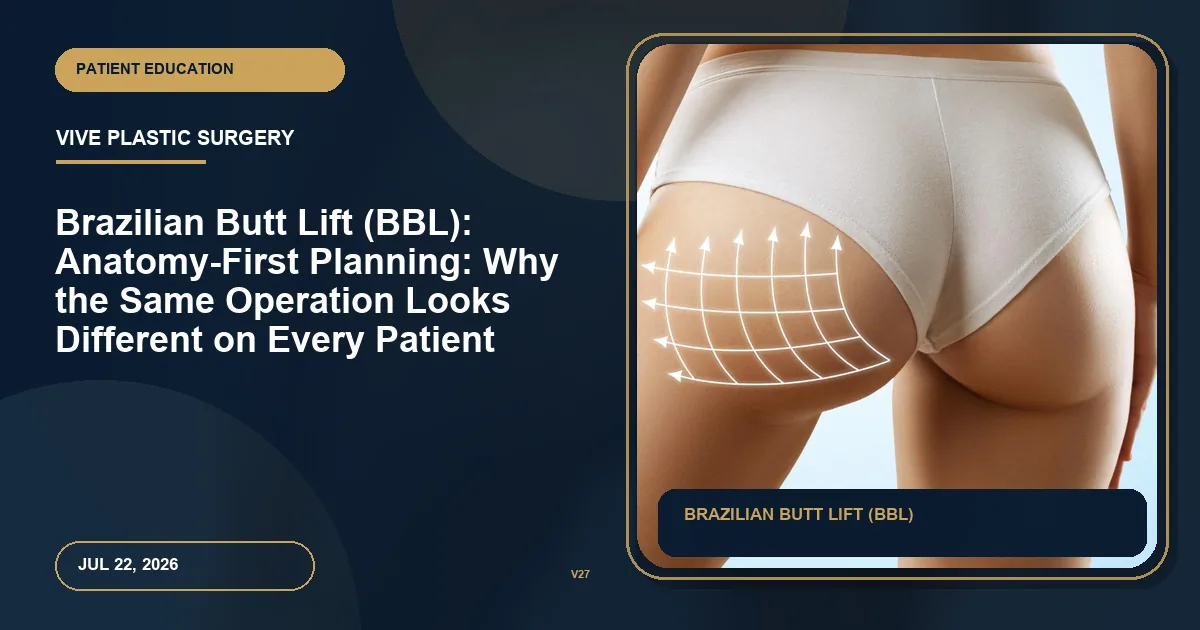
Brazilian Butt Lift (BBL): Anatomy-First Planning: Why the Same Operation Looks Different on Every Patient
People researching Brazilian Butt Lift (BBL) often find ideal outcomes and average timelines. This guide focuses on anatomy-first planning, the practical layer that turns general information into useful questions for a medical consultation.
A practical Brazilian Butt Lift (BBL) guide focused on anatomy-first planning: candidacy, preparation, risks, results and questions before scheduling in Tijuana.
What Brazilian Butt Lift (BBL) can and cannot do
A Brazilian Butt Lift uses liposuction to harvest fat and transfers selected fat to the buttocks. It is a complex operation whose safety depends on patient selection, facility standards, surgeon training and strict control of the injection plane.
The procedure should answer a defined diagnosis and goal. A responsible consultation explains alternatives, the option not to treat, expected duration and how change will be measured without promising perfection. Marketing may simplify the process; informed consent should restore the important details.
A practical plan for anatomy-first planning
Define the goal before choosing the date
Write down the change you want, what would count as enough and which commitments cannot move. Measurements, tissue quality, proportions and baseline asymmetry shape the operation. Reference photos can communicate preferences, but they cannot replace an examination or turn another person's anatomy into a promise.
Build a buffer, not a perfect date
Timelines are ranges, and an individual response can be slower than an average. Swelling changes both donor and grafted areas. Some transferred fat does not survive, so early size is not final; long-term contour also responds to weight change and aging.
Secure follow-up before treatment
Save written instructions, clinical photographs and a reliable contact route. If you travel, agree on who responds after you return and when a concern needs in-person assessment.
Who may be a candidate for Brazilian Butt Lift (BBL)
Evaluation should cover overall health, anemia and clot risk, available donor fat, skin quality, nicotine, weight stability and whether the requested shape is anatomically realistic.
The absence of a contraindication does not automatically make a procedure the best choice. The clinician should compare likely benefit with risk, cost, maintenance and alternatives. When expectations exceed what the technique can deliver, saying no or proposing a different path is part of good care.
Consultation and personalized planning
Complete health history
Evaluation should cover overall health, anemia and clot risk, available donor fat, skin quality, nicotine, weight stability and whether the requested shape is anatomically realistic.
Product, device or technique transparency
Ask whether real-time ultrasound is used throughout fat injection, how the surgeon confirms a subcutaneous plane, procedure-volume limits and emergency-transfer arrangements.
Timing and aftercare
Follow the surgeon's positioning, compression, walking, hydration and travel plan. Know the emergency signs of blood clots, pulmonary problems, infection and fat embolism.
Results, recovery and maintenance
Swelling changes both donor and grafted areas. Some transferred fat does not survive, so early size is not final; long-term contour also responds to weight change and aging.
Agree in advance on when photographs will be taken, when the outcome should be assessed and what would justify another session. Treating before swelling resolves or before the expected biologic response can lead to overcorrection and unnecessary expense.
Risks and warning signs
BBL carries serious risks including fat embolism, blood clots, bleeding, infection, contour irregularity, fat necrosis and need for revision. Ultrasound guidance and subcutaneous-only injection are central safety questions.
Request written instructions and an urgent contact route. Severe or escalating pain, marked color change, trouble breathing, visual symptoms, weakness, fever or rapidly progressing symptoms should not be managed only through messages; they require the level of evaluation directed by the medical team.
Choosing care in Tijuana
Verify professional credentials, procedure-specific training, product or device identity and traceability, consent, sanitation, clinical photography and follow-up. If you cross from the United States, include border and transportation time without sacrificing observation or checkups. A clear quote should explain inclusions and who responds if the plan changes.
Frequently asked questions
Is Brazilian Butt Lift (BBL) appropriate for everyone?
No. Candidacy depends on health, anatomy, diagnosis, medications, previous procedures and expectations. An evaluation may conclude that it is better to wait, choose another option or avoid treatment.
When is the result of Brazilian Butt Lift (BBL) considered final?
Swelling changes both donor and grafted areas. Some transferred fat does not survive, so early size is not final; long-term contour also responds to weight change and aging.
What question matters most about anatomy-first planning?
Ask how the plan changes for your case, what alternative exists and what follow-up is available if recovery differs from the average. Ask whether real-time ultrasound is used throughout fat injection, how the surgeon confirms a subcutaneous plane, procedure-volume limits and emergency-transfer arrangements.
Your next step
Schedule a consultation with VIVE Plastic Surgery to determine whether Brazilian Butt Lift (BBL) fits your goal and to build a plan with clear timing, limits and follow-up. Bring your medication list, relevant history, prior procedure details and questions about anatomy-first planning.
Medical notice: This educational content does not replace an individual evaluation, diagnosis or treatment recommendation. Every medical procedure has benefits, limits and risks. Results vary.
Reference sources for editorial review
ASPS: Gluteal Fat Grafting Joint Safety Statement: https://www.plasticsurgery.org/documents/Patient-Safety/BBL/Gluteal-Fat-Grafting-Safety-Advisory_Aug22.pdf
ASPS: Liposuction: https://www.plasticsurgery.org/cosmetic-procedures/liposuction
Reviewed against the site's existing post sitemap on July 22, 2026. Editorial medical review is recommended before publication.